







Influence of Environmental Factors on Fertile Soil Yield
Introduction
Fertile land is a vital resource for agricultural productivity, which directly supports food security and the economy of a region. However, the productivity of fertile land is heavily influenced by various ecological factors, including climate, soil characteristics, water availability, biodiversity, and human activities. Productivity of fertile land is influenced by multiple ecological factors, with complex interactions between them. Climate, soil characteristics, water availability, biodiversity, and human activities all play crucial roles in determining land productivity. Water availability is a primary regulator of plant productivity, especially in arid and semi-arid ecosystems {Serafini et al.,2019).In temperate mesic grasslands, soil moisture availability interacts with nutrient supply to influence productivity. Under normal conditions, shoot productivity is primarily limited by soil nutrient supply, but water availability becomes the primary constraint during drought (Serafini et al.,2019).
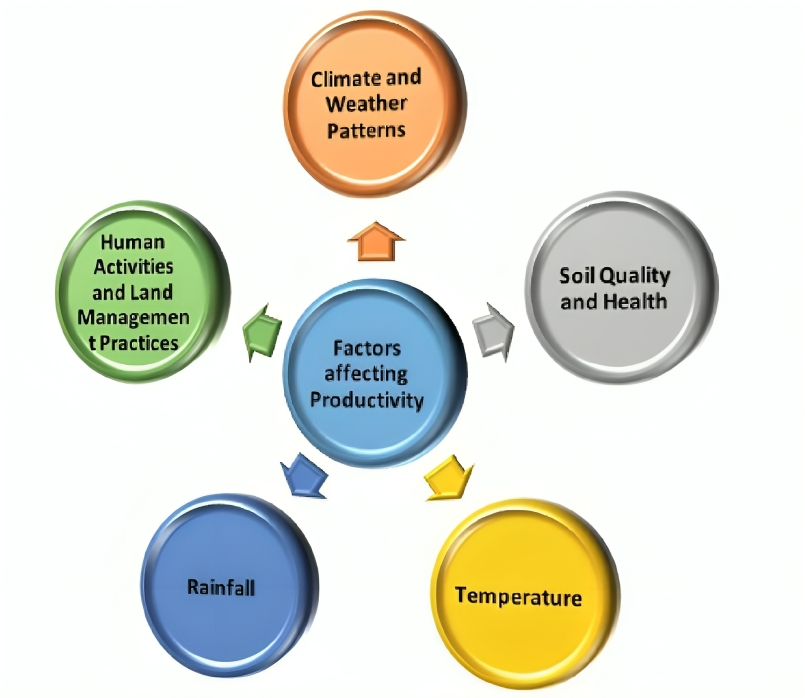
Understanding the interplay between these factors is crucial for sustainable land management and agricultural practices. This article will explore how ecological factors impact the productivity of fertile land and the strategies to mitigate negative effects (Fig.1.)
1. Climate and Weather Patterns
Climate is one of the most significant ecological factors affecting and productivity. Temperature, rainfall, humidity, and sunlight significantly impact crop growth and yield across various regions and crops, as evidenced by multiple studies: Rainfall plays a crucial role in crop production, especially in rainfed ecosystems. In Dharmapuri District, India, analysis of 100 years of rainfall data revealed that 56.3% of months had normal rainfall distribution, while 34.1%were drought months. This information he ped identify available 120-day growing period from August to December for annual cropping (Parasuraman& Mani,2012). Similarly, in Khulna city, changes in rainfall patterns over four decades showed varying impacts on different seasons, affecting crop production (ArefinSiddikui & Nahida Sultana, 2024).The relationship between these factors and crop yield is not always straight forward. For instance, in Jodhpur district, western Rajasthan, rainfall positively influenced bajra. kharif pulses, and sesamum yields, while mean temperature had a negative impact. Mean relative humidity showed a weak influence on crop productivity (Vyas et al.,1985). In contrast. a study on maize cultivars found that number of leaves was most sensitive to rainfall, minimum temperature, and relative humidity, while plant height and leaf area were more responsive to maximum temperature and sunshine hours, respectively (Makinde et al.,2019). Optimal temperatures and adequate rainfall can enhance crop yields, while extreme weather conditions-such as droughts, floods, and heat waves – can lead to crop failure and soil degradation.
Temperature :
Temperature plays a crucial role in seed germination and early seedling growth across various crop species. Different crops have specific optimal temperature ranges for germination and growth, with extreme temperatures often inhibiting these processes. For lnstance, Medicagotruncatula showed distinct quantitative trait loci (QTLs) for germination at suboptimal(5 or 10ºC) and supra-optimal(20ºC) temperatures (Dias et al.,2010). Sophoradavidii exhibited maximum germination (30.67%) at a constant temperature of 20ºC (Wang et al.,2016).For Zostera marina, the optimal water temperature for seed germination ranged from 10 to 15ºC, while seedling growth was optimal between 20 to 25ºC (Abe et al.,2008) . Picnomonacarna seeds germinated over a wide temperature range from 5 to 35ºC with highest germination at 20ºC constant and 20/10ºC fluctuating temperatures (Nosratti et al.,2019).Some crops show adaptability to extreme temperatures. Fiber sorghum, typically requiring temperatures above 10ºC for germination, demonstrated high cold tolerance with 82.4% germination at 8ºC for certain cultivars (Patane et al., 2012). Similarly, many cover crop species were found to be adapted to summer sowing with relatively high optimal temperatures for germination, although some Fabaceae species were more sensitive to high temperatures (Tribouillois et al.,2016).
Rainfall
Rainfall patterns significantly impact crop health and yield, with both drought and excessive rainfall posing threats to agricultural production. Drought consistently decreases maize yield due to water deficiency and concurrent heat, with greater yield loss for rainfed maize in wetter areas (Li et al.,2019). Excessive rainfall can have either negative or positive impacts on crop yield, varying regionally. In cooler areas with poorly drained soils, excessive rainfall can decrease maize yield significantly, especially under high preseason soil water storage conditions (Li et al.,2019).The impact or excessive rainfall on crop yield remains less understood compared to drought effects. Observational evidence shows that excessive rainfall can reduce maize yield by up to -34% (-17± 3% on average) In the United States, comparable to the up to -37% loss caused by extreme drought (-32 ± 2% on average) from 1981 to 2016 (Li et al.,2019). In dry environments like West Africa, excessive soil water associated with heavy rainfall events can have detrimental effects on cowpea yields, particularly in areas with poorly drained soils (lizumi et al.,2023) .To mitigate the impacts of irregular rainfall patterns, various strategies can be employed. Effective crop planning with appropriate sowing time short duration crops, and high yielding drought-resistant varieties can help better utilize monsoon rain and reduce water stress (Manivasagam & Nagarajan, 2017). In arid and semi-arid regions with limited water availability, dry farming techniques and water harvesting methods can be implemented to cultivate drought-resistant crops (Feddes & Bastiaanssen, 1992).The development of crop· specific drought indices can aid in assessing moisture stress and guiding irrigation management decisions (Mcdaniel et al., 2017).
Read more...