
Tiny Pollutants, Massive Impacts: The Growing Threat of Microplastics
Panna Chandra Nath, PhD, Research Associate, Think Tank Department, Mobius Foundation, Connaught Place, New Delhi, India; Aditya K Joshi, PhD, Advisor, Think Tank Department, Mobius Foundation, Connaught Place, New Delhi, India
Microplastics: What are these?
Microplastics, a word used to describe small pieces of plastic particles less than 5 mm in size, have entered every part of our ecosystem and are becoming a serious threat to biodiversity and human health. Microplastics in the environment are usually of two types, primary and secondary. Primary microplastics are the microbeads, pellets, and other synthetic materials used in our day-to-day products. Secondary microplastics are shredded micro-pieces formed from large plastic materials due to weathering and exposure to environmental stresses. Recent global studies show that microplastics have contaminated ecosystems, including indoor and outdoor air, which when inhaled, can travel throughout the body and accumulate in different organs, particularly in human lung tissues.
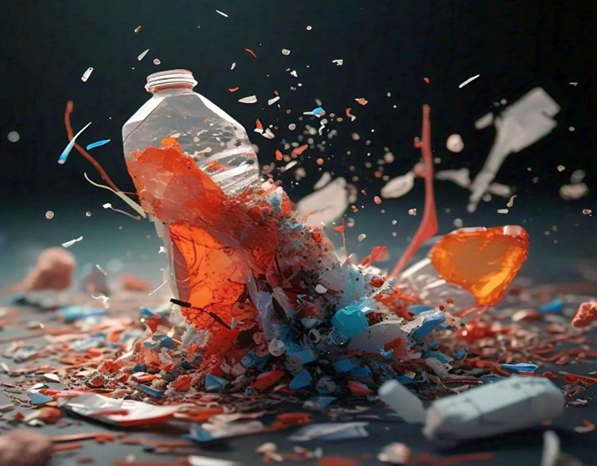
Representation of the generation of microplastics from plastic waste in the environment (Image generated using Meta AI)
Global Context
Annually, about 350 MMT plastic waste is landfilled globally or ends up in water bodies, where it disintegrates into microplastics through weathering processes. An average of almost 300 thousand tonnes of primary microplastic particles and 530 thousand tonnes of secondary microplastic particles are released into the environment every year around the world. According to estimates, the world’s oceans contain a total of 24.4 trillion microplastic particles weighing 10 MT, and the projections suggest that the microplastic loadings will double by 2030 under similar trends. Studies show the annual human consumption of microplastic particles varies from 4,000 to 52,000 particles from packaged food items, with the figures increasing to 1,21,000 when inhaled microplastic particles are included.
Microplastics have been observed in pristine environments; in the Southern Ocean and Antarctic regions. Researchers have discovered microplastics in the intestines of several species in the Southern Ocean and Antarctic regions, including penguins, seabirds, fur seals, and fish, suggesting that they have contaminated the food chain in these remote areas. The ultimate transfer of microplastic particles into groundwater and below-ground aquifers has resulted in an excessive quantity of microplastics in tap and bottled water worldwide. A study observed loadings of microplastics in eleven major brands of bottled water sourced from 10 countries including the source supply amazon.com, which ranged from 32 to 10,390 particles per liter. More than 80% of the microplastics in bottled water are from plastic products, packaging, textiles, and electronic gadgets.
Indian Scenario
Plastic mulching is a common practice to reduce moisture loss from agricultural soil in India. This in addition to hoses and packaging materials for agrochemicals has been identified as one of the primary sources of microplastic pollution in farm soil. The spatial loadings of microplastics show that river Alaknanda is the most polluted among the major rivers of India having 2,260 floating particles per cubic meter. While considering river sediment, the River Ganga shows the worst case with an average microplastic loading of 4,319 particles per kg of sediment soil, which ranges from 11 to 91,123 particles per kg. Average microplastics deposited in the sediment of other rivers namely, Ulhas, Alaknanda, Kaveri, Netravathi, Indus, and Brahmaputra ranged between 131 (9 – 253) and 998 (20 – 2,649) particles per kg.
Poorly disposed municipal waste is a major source of microplastics in India’s freshwater ecosystems. The microplastics enter the food chain through plankton and benthic organisms to fish sold in local and national markets. In a recent study in Northeast India, researchers found an abundance of microplastics ranging from 4 to 52 particles in the commonly eaten and highly marketed fish varieties of Loktak Lake (Ramsar Site) in the state of Manipur, India. Microplastics are largely found in the marine environments throughout India’s southeast, southwest, and western coastlines. According to reports, the abundance of microplastics in coastal sediments reaches up to 1,150 particles per kg, with a mass of up to 4,748 mg per sq. m.
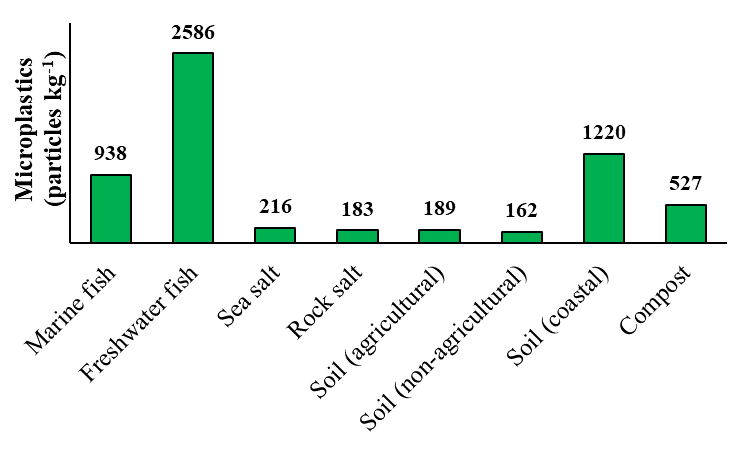
Average microplastic concentration in different sources (Sources: Yaranal et al. 2021; Vidyasakar et al. 2021; Harikrishnan et al. 2023; Pandey et al. 2023; Prusty et al. 2023; Reethu et al. 2023; Bhavsar et al. 2024; Borah et al. 2024; Motivarash et al. 2024; Surendran et al. 2024; Vittal et al. 2024)
The Indian Himalayan ranges are considered to have pure ecosystems; however, they are now contaminated with microplastics, with quantities ranging from 600 to 2,500 particles per cubic meter. Indian compost, with an average microplastic concentration of 1220 particles per kg, continues to be one of the primary sources of increasing microplastic pollution. Compost made from unsegregated municipal solid waste may be the primary source of microplastic pollutants in the soil. Particles from the soil ecosystem have even contaminated the edible salts in India.
Adverse Effects of Microplastics
Microplastics aid in the translocation of heavy metals, pathogens, coliforms, pollutants, and inorganic chemicals, and provide ideal conditions for the establishment of microbial biofilms containing algae, fungi, bacteria, and others making them potential vectors of diseases and other health hazards. In marine animals, ingestion of microplastic particles alters gastrointestinal physiology, suppresses the immune system, induces oxidative stress, and causes stunted growth, whereas in humans, exposure causes particle accumulation in tissues. Microplastic pollution is also fatal for some corals, such as Scleractinia, and interferes with soil biota, affecting nutrient cycling, which is necessary for plant growth. Airborne microplastics accumulate in the respiratory system and are ingested through food, potentially entering the bloodstream, where they bioaccumulate in tissues and may disrupt normal body functions.
Limitations and Way Forward
It is evident that microplastics have contaminated most of the Indian ecosystems and have made their way to our food chains. It therefore becomes essential to explore the full extent of microplastics in different ecosystems in India and their potential for fatality. Scientific advancements to remove the microplastics directly from the environment are not known yet. A recent innovation by scientists from the Indian Institute of Science has developed a technologically complex substance namely, ‘hydrogel technology,’ which can significantly remove microplastics from a controlled environment. However, the implementation of technological advancement lacks information on its abilities in the real, exposed, and dynamic environment. Therefore, the current mitigative measures of microplastic pollution primarily rely on the proper implementation of the 5Rs, viz. Refuse, Reduce, Reuse, Repurpose, and Recycle. Moreover, generating awareness among people is required to reduce the use of plastic products and scientific waste disposal. Collaborative efforts at all levels from individuals, communities, NGOs, and governments are also required to minimize waste generation. Industrial innovations should be more environment friendly such as introducing eco-friendly packaging and increasing durability of the products.