
The Global Challenge of E-Waste Crisis
By Yogesh, PhD, Assistant Professor, Sikkim Manipal Institute of Technology, Gangtok, India
The use of electronic equipment has increased dramatically due to the accelerated growth in the IT and communication sectors. According to the report entitled ‘Digital Use Around the World in July 2020’ by Simon Kemp, the rate of increase in internet and mobile phone usage in the world population surged from 2.4% in July 2019 to 8% in July 2020. Currently, about 60% of people on the planet use mobile phones and internet. India is among the top countries in the world in terms of smartphone sales and usage, as well as internet usage, according to the Economic Times. The annual report of the Indian Ministry of Commerce and Industry, India states that India imported electronic goods worth around 55475.52 million USD during the 2018–19 fiscal year.
In the present times, electronic garbage or e-waste is more frequently generated because consumers discard their electronic items within a short period due to the rapid pace of recurrent technological advancements. Numerous additional factors also contribute to the rise in e-waste, such as inadequate infrastructure, a dearth of awareness, lack of repair/reuse, outdated technology, poor reporting systems, and many more. Thus, e-waste has emerged as the world’s fastest-growing type of solid waste. E-waste production is thought to have reached 50 million tonnes globally in 2018 and is continuing to grow rapidly. Greenpeace states that the per capita production of e-waste is the highest for industrialized nations of Europe and America contributing more to the global annual production of roughly 50 million metric tonnes of e-waste. The highest quantity of e-waste (nearly 24.9 million metric tonnes) is produced in Asia, followed by America and Europe in second and third positions respectively.
Electronic junk is among the entities that deteriorate the surroundings, and any hazardous and toxic materials and chemicals present in it cause significant environmental issues. Some electronic items have flat panel liquid crystal displays that need fluorinated greenhouse gases having an atmospheric lifetime of 3000 years. The waste items containing environmentally detrimental substances, which range from discarded cell phones to televisions, are mostly disposed of in landfills. Recycling provides the best solution to the problem of e-waste. The process of e-waste recycling consists of four steps: collection, sorting, disassembly, mechanical, and chemical processing, after which the raw material is recovered. Apart from landfills and recycling, some other methods of e-waste disposal and management are acid baths, incineration, leaching, and reuse. Every electronic product differs in its material composition. Consequently, there is a difference in how various kinds of e-waste need to be managed and recycled, as well as their level of harmfulness to the environment and people’s health, if not managed properly.
Many countries have recently prohibited the export of e-waste and have implemented distinct laws for the correct disposal of e-waste. For instance, in India, the E-waste Amendment Act 2018, has been enacted to regulate the e-waste ecosystem. Electronic wastes are also under the governance of the Basel Convention on Control of Transboundary Movements of Hazardous Wastes and Their Disposal. Although several frameworks have been formulated by numerous countries to manage e-waste appropriately worldwide, the majority of it is still dumped in landfills, burned, shipped to poor countries, or disposed of by unauthorized people. Research conducted at the United National University, Tokyo, Japan, revealed that 53.6 Mt (i.e. 7.3 kg per person on earth) of e-waste was produced worldwide in 2019, out of which only 17.4% was properly recycled. Thus, the remaining 82.6% of the waste had to be categorized as having an unclear final point.
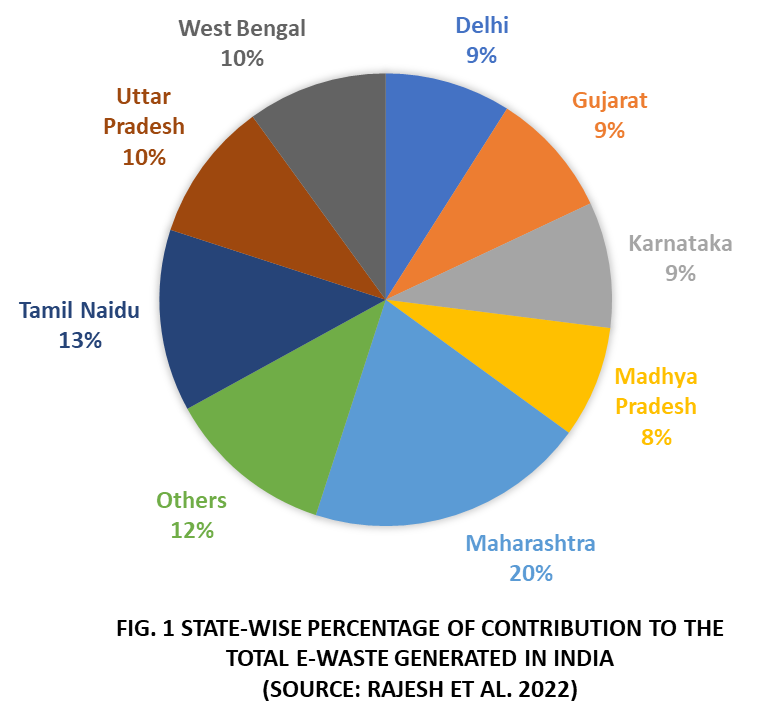
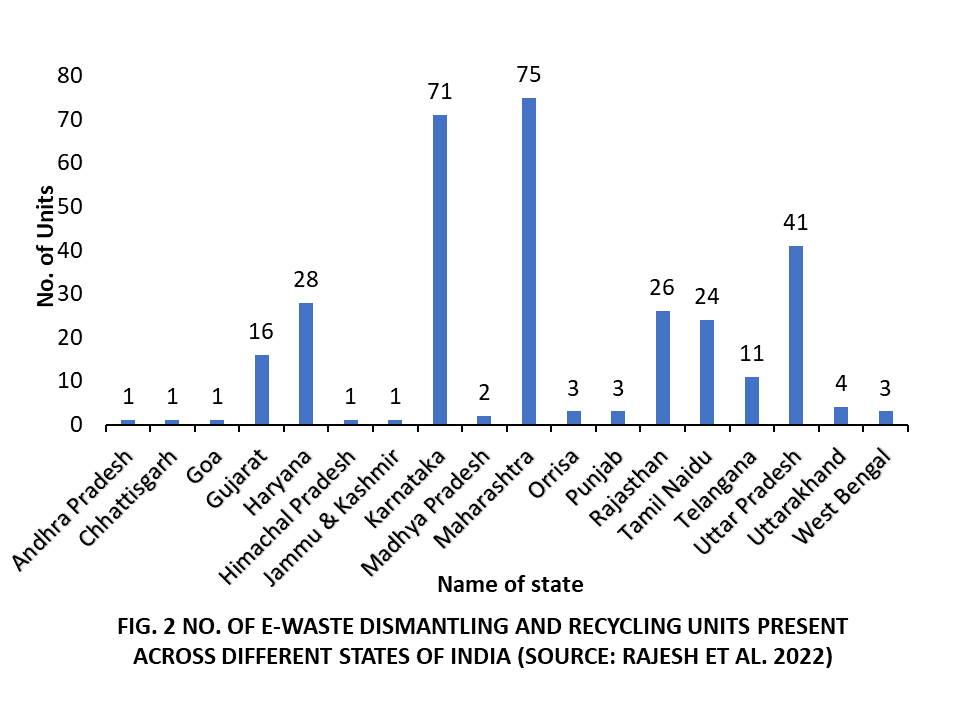
India produced almost 12.5 lakh metric tonnes of e-waste in 2014 and this number sharply climbed by 2 million tonnes in 2018; however, only 4,38,085 tonnes of the waste is collected and recycled every year, according to research conducted by the Associated Chambers of Commerce and Industry of India. Overall, in India, just 5% of all electronic trash is adequately collected and recycled, whereas the remaining 95% is handled by the unorganized sector. The state-wise percentage of contribution to e-waste generation in India is depicted in Fig. 1. From the figure, it is evident that, among all the Indian states, the contribution of Maharashtra is the highest in terms of the total amount of waste produced in the country. There are 312 authorized e-waste dismantling/recycling units in India, out of which the highest numbers of units are located in Maharashtra and Karnataka (Fig 2).
According to Greenpeace, the informal recycling of e-waste in many countries such as China, India, and Nigeria, harms the environment and people’s health. Workers in unlicensed disposal facilities are likely to be severely impacted because they might not be provided with proper protective gear. Additionally, the health of people residing in the vicinity of landfills and incinerators used for e-waste disposal might also be negatively affected. Due to the complex composition of e-waste and the ever-increasing quantities of such waste, recycling is becoming more difficult in many developed countries. As a result, the environment is negatively impacted in numerous ways. The expanding e-waste problem necessitates a greater focus on recycling and improved e-waste management. To solve the problems related to e-waste management, governments should focus specifically on implementing efficient policies, formulating proper management strategies, and remedial methods as well as promoting awareness. In general, governments, industries, and individuals need to collaborate in finding sustainable solutions to mitigate the impact of e-waste on the environment and human health, and in this way pave the way for a sustainable future.
Sources
Rajesh R, Kanakadhurga D, Prabaharan N. 2021. Electronic waste: A critical assessment on the unimaginable growing pollutant, legislations and environmental impacts. Environmental Challenges 7, doi: 10.1016/j.envc.2022.100507