



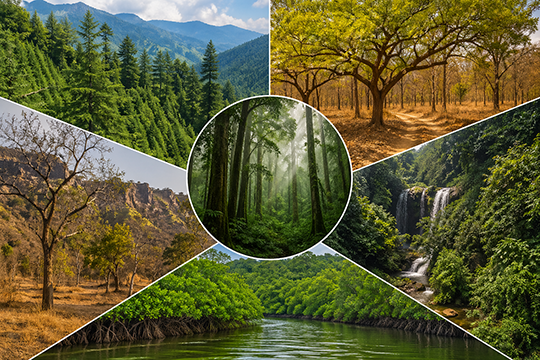
FOREST ECOSYSTEM: FOREST TYPES OF INDIA
Dr. Sharda1 R. Gupta2
Introduction:
Forests in India are very diverse in their composition with a long evolutionary and geological history, occurring under diverse climatic and edaphic conditions. The forests represent a very unique assemblage of both Indo-Malayan and Australian species indicating the geological and paleo-botanical value of these forests. The forest types of India were classified for the first time in 1936 by Sir HG Champion and compiled his monumental work ‘Preliminary Survey of Forest Type of India and Burma’ (Champion 1936). Champion and Seth classified India’s forests into 16 major types and about 221 sub-type groups; published ‘A Revised Survey of the Forest type of India’ in 1968. The detailed classification of forest types in India is based on climate, physiognomy, species composition, phenology, topography, soil factors, altitude, aspect, and biotic factors (Champion and Seth, 1968). The forests have been classified into six “major groups”, ranging from tropical to alpine These major groups have been further classified into 16 sub-groups on the basis of temperature and moisture regimes, and more than 200’group categories'(see, Singh and Chaturvedi, 2017).
Major Forest Types:
At the beginning of the 20th century about 30% of land in India was covered with forests. But by the year 2015 the forest cover has been reduced to 21.34%. In 2015, of the existing forests, about 2.61% are very dense forests (canopy cover 70% or more), 9.59% moderately dense forests (canopy cover 40% or more but less than 70%), 9.14% open forests (canopy cover 10% or more but less than 40%), and 1.26% scrub forests (canopy cover less than 10%) (FSI 2015). Mizoram, with 88.93% of forest cover has the highest forest cover in percentage terms, followed by Lakshadweep (84.56%). Madhya Pradesh is having largest total forest cover (77, 462 km2) in India, followed by Arunachal Pradesh (67,248 km2) and Chhattisgarh (55,586 km2) (FSI 2015).
Table 25. 1. The major forest types of India (based on Champion and Seth, 1968)
Major Forest Groups Forest Groups:
1: Moist Tropical forests Group1: Tropical Wet Evergreen Forests Group
2: Tropical Semi-evergreen Forests Group
3: Tropical Moist Deciduous Forests Group
4: Littoral and Swamp Forests II. Dry Tropical forests Group
5: Tropical dry deciduous forest Group
6: Tropical thorn forests Group
7: Tropical dry evergreen forests III. Montane Subtropical Forests Group
8: Subtropical broad-leaved hill forests Group
9: Subtropical pine forest Group
10: Subtropical dry evergreen forests IV. Montane Temperate Forests Group
11: Montane wet temperate forests Group
12: Himalayan moist temperate forests Group
13: Himalayan dry temperate forests V. Sub alpine forests Group
14 Sub alpine forests VI. Alpine Forests Group
15: Moist-Alpine Scrub Group
16: Dry-Alpine Scrub