











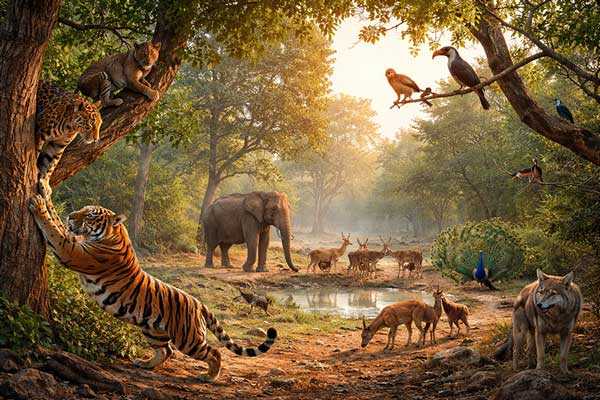
THE REMARKABLE COMMUNICATION SYSTEM OF WILD ANIMALS
Dr. A. D. Kholkute
Abstract
Wildlife communication is one of nature’s most sophisticated and adaptive systems. Despite lacking human technological tools, wild animals interact flawlessly through a complex network of sensory and behavioral signals. This paper explores the acoustic, visual, and olfactory communication mechanisms in wild species, particularly in Indian ecosystems such as Tadoba, Pench, and Nagzira. It also emphasizes the ecological significance of territorial marking, mating behavior, and the human responsibility in wildlife conservation.
1. INTRODUCTION:
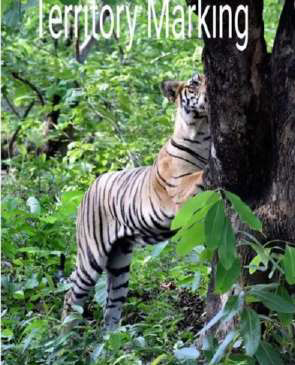
In recent years, wildlife tourism in India has increased significantly, with visitors drawn to national parks primarily to observe charismatic megafauna such as the tiger (Panthera tigris). However, most visitors remain unaware that animals are already aware of human presence long before being seen.
Unlike humans-who depend on advanced telecommunication systems, electricity, and network connectivity-wild animals rely on an innate communication system gifted by nature. This system never fails, for it is based on instinct, sensory evolution, and environmental adaptation. Wild animals utilize sound, smell, visual cues, and body gestures to detect the presence of others. In the wild, communication failure can mean death, as survival depends on awareness of both predators and prey. Every species occupies and defends a specific territory, ensuring access to food, shelter, water, and breeding grounds.
Read entire article: Me & My Earth