







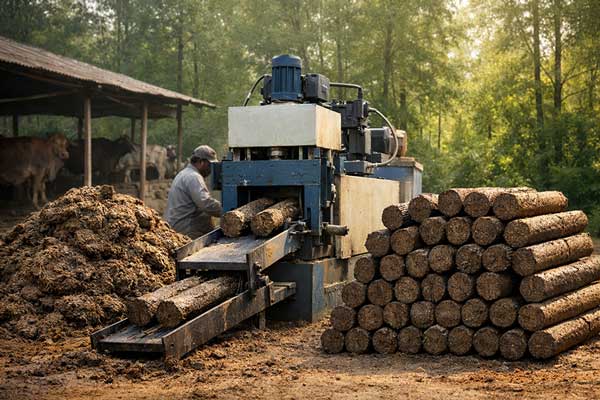
COST – BENEFIT ANALYSIS OF GAUKASTH MACHINE (RAMKALI GAUSHALA- HALALI DAM): IMPACT ON ENVIRONMENT AND FOREST CONSERVATION
Dr SP Singh Dr Sunil Kumar Dr Chitra Prabhat
Key words:
Cost-Benefit, Environmental Benefit, Conservation,
Abstract
This paper is an outcome of the programme conducted by the First author under different training programmes. This paper discusses about the cost benefit analysis of GauKasth machine installed in Gaushalaat Ramkali, Halali Dam, Raisen MP and Other one is at Mugaliachap Village, Bhopal. It involves comparing the total costs incurred in installation with the benefits generated over time. Other than the cost and benefit, the environmental, social and economics benefit has also been observed in in the study area. The objective of this study is, to identify the most cost-effectiveness of the Gaukasth machine, followed by other objectives To reduce the dependence on forest cover and saving trees by replacing Fuelwood with Gau-kasth, To sustain the gaushala by using the cow-dung of more than 2000 cows in the gaushala, To utilise this cow dung by adopting Technology for the GauKasth production, To search out the market for the creating a supply with an aim to earn revenue for sustaining gaushala., To produce and procure dry fodder and husk for the Bovine animals (not productive for villagers to get the milk product), To analysis the cost benefit of Gaukasth machine. How this innovation can be linked withViksit Bharat 2047.
The CB methodology have been used in this study.
The study concludes and suggest how the environmental benefit are helpful in mitigating the impact of climate change, how the fuelwood has been substituted by gaukasth which has resulted in creasing Environmental and forest conservation by saving the depletion of trees. Further, it also suggest that The Replacement of Fuelwood has been reduced where the supply linkages has increased in the Funeral or Samshanghat because of the socio and religious factor and reduces pollution by 30%. The substitute of Fuelwood during Holi festival has also resulted in the increased per capita consumption of Gaukasth instead of fuelwood linked with environment and forest conservation and saving trees every year. The gaukasth has future potential to be used as energy source for generating electricity this will in reducing the use of coal, fossil fuel etc. This innovation and future potential of increased turnover by machine also aligned with make in India, must be replicated in other gaushala for sustaining Livestock population and resulting in sustainable livelihood of people engaged in gau- shala.
INTRODUCTION
This study is an outcome of Three training programme coordinated by the author. This study is field based one till date less literature or no literature is available to document the role of Gaukasth machine on and its impact on Environment and forest conservation. However the first attempt was made by Dr Y K Saxena, Scientist of Central Pollution Control Board to install the first machine at Anarkali Gaushala near Halali Dam near by District Raisen Madhya Pradesh.
Some of the work has been done by the first author C B analysis of Professional Education in NRM (Singh, etal. 2024) Cost-Benefit Analysis of Agroforestry Products ((Singh and Sonali, 2025), However less work has been done in CB analysis of the gaukasth machine.
Read entire article: Me & My Earth